
Thu, Dec 10
|Online (Zoom link sent after registration)
Help Your Child Think Independently and Write Clearly
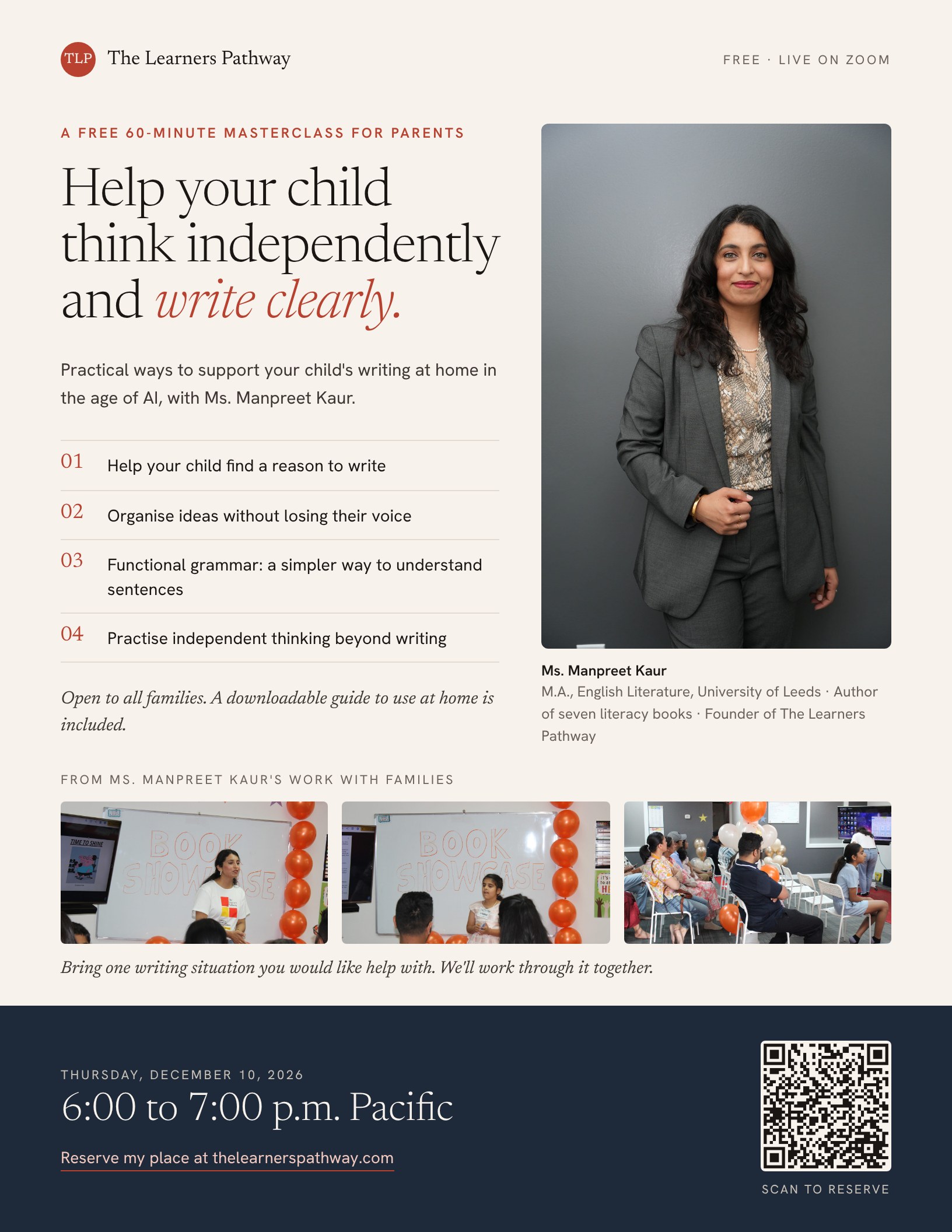
A free 60-minute masterclass for parents and caregivers with Ms. Manpreet Kaur. Practical ways to support your child's writing at home in the age of AI: what to ask, what to practise, and when to step back so your child can develop their own ideas and put them into words. Live on Zoom. Open to all families. Guide emailed after the session.
Time & Location
Dec 10, 2026, 6:00 PM – 7:00 PM
Online (Zoom link sent after registration)
About the event
A free 60-minute masterclass for parents and caregivers
Practical ways to support your child's writing at home in the age of AI
One hour with Ms. Manpreet Kaur to understand what gets in the way of your child's writing and how you can help.
Learn what to ask, what to practise, and when to step back so your child can develop their own ideas and put them into words.
Thursday, December 10, 2026 · 6:00 to 7:00 p.m. Pacific · Live on Zoom
Open to all families · Guide emailed after the session
M.A., English Literature, University of Leeds · Author of seven literacy books · Founder of The Learners Pathway
Ms. Manpreet Kaur opening the TLP Book Showcase A young TLP author presenting her book Families at the TLP Book Showcase
From the TLP Book Showcase, where students present the books they have written.
“My kids now spend less time on screen and have started reading more. They have also started to talk in a lot smarter way.”Kiran K., TLP parent
“When we first started six months ago, they were in this shell. I feel like they’ve broken out of that shell. They’re thinking and expressing themselves.”Diana E., TLP parent
“The Learners Pathway not only helped him with his literacy, vocabulary and writing skills, but also built his confidence and his self-esteem.”Sukhneet B., TLP parent
In a world of AI, your child's thinking matters most
In a world increasingly shaped by technology, thinking independently is one of the most important skills your child can develop. That means forming their own ideas, explaining their reasons, and finding the words to express what they mean.
Writing puts these skills into practice. Choosing an idea, deciding which details belong, and constructing a sentence all ask a child to think about what they want to say. As children write, they practise organising their thoughts and expressing them with purpose.
At home, you can help make space for that thinking. You can also help your child experience writing as something worth doing: a way to share an opinion, remember a moment, ask for a change, or tell a story.
This masterclass brings those two parts together: helping your child build a relationship with writing and giving you practical ways to support the skills behind it.
What you'll learn
Open each lesson to read more.
01. Help your child find a reason to write
If writing mostly means assignments and corrections, a child may struggle to see why they would choose it for themselves.
We'll begin with what writing feels like to your child. You'll explore ways to make it meaningful, from recommending a favourite game to writing a note that matters to someone.
You'll also learn how to respond to what your child is trying to say, then choose a manageable next step for improving the writing.
A question to take home: “What would you like someone to know?”
02. Help your child organise ideas without losing their voice
Your child may have plenty of ideas and still lose their point halfway through a paragraph. Sometimes the difficulty is choosing which ideas belong together and which ones can wait for another piece.
You'll learn a short planning conversation that helps them choose a main point, select the details that belong, and decide what comes first.
We'll work through a rambling example together so you can see how to guide those decisions while keeping the ideas and words your child's own.
A question to take home: “What is the one thing you want your reader to understand?”
03. Functional grammar: a simpler way to understand sentences
You'll discover a simpler, more practical approach to helping your child with sentence structure and grammar.
Functional grammar looks at how words and sentences work to express meaning. Contextual grammar connects that understanding to the writing children read and create.
Through everyday examples, you'll learn how to help your child recognise a complete thought, arrange words clearly, and connect ideas. You'll see how to talk about grammar in a way your child can use in their own writing.
A question to take home: “Does this sentence say what you meant?”
04. Practise independent thinking beyond writing
In everyday conversations, you can help your child explain a reason, consider another possibility, and make a decision.
You'll learn questions to use during reading, family choices, and moments when your child says, “Can you just tell me?”
We'll also discuss how to keep children involved in forming ideas, checking information, and explaining their choices when digital tools are available. You'll consider when a prompt helps and when your child needs time to think.
A question to take home: “What else could explain that?”
What we'll do in the hour
You'll see examples, try questions you can use with your child, and choose a first step for home.
Bring one writing situation you would like help with. Perhaps your child avoids starting, writes without a clear direction, or waits for you to approve every sentence. Keep it in mind as we work through the examples.
A guide to use at home
You'll receive a guide with the key ideas, practical questions, and writing routines from the masterclass. Keep it nearby when you want to revisit an approach or try something with your child.
A starting point when your child feels stuck
When your child says, “Just tell me what to write,” you might begin with:
“Tell me one thing you want your reader to understand. We'll start there.”
Learn how to build from their answer into a short plan, then help them use the same question on their own.
A habit of explaining a choice
When your child offers an opinion, try:
“What makes you say that?”
“Could someone see it differently?”
You'll practise using questions like these in everyday conversations and learn when to ask another question and when to give your child time.
Meet Ms. Manpreet Kaur
Educator, author, and founder of The Learners Pathway

Manpreet Kaur holds an M.A. in English Literature from the University of Leeds and is the author of seven literacy books for young learners.
She is the creator of the Literacy and Independent Learning System. Her work focuses on helping children think, write, and learn with increasing independence.
In this masterclass, she brings that approach into the moments families know: a child facing a blank page, an idea that gets lost in a paragraph, or a writer ready to express a more thoughtful point of view.
“Literacy is the ability to think clearly, communicate with purpose, and lead your own learning.”
This masterclass is for you if…
Your child has ideas but struggles to put them into words.
Writing often involves repeated reminders, reassurance, or help getting started.
Your child writes readily, and you want to help them develop more depth and clarity.
You want to understand when to help and when to give your child space.
You're thinking about how to support your child's independence in a world shaped by technology.
Parents and caregivers of children of all ages are welcome, whether you homeschool or support your child alongside school. The focus is on what you can say and do in everyday moments at home.
Questions parents may have
Do I need to be confident in grammar to attend?
You don't need teaching experience or specialist terminology. We'll use everyday language and sentence examples so you can see what to notice and how to talk about it with your child.
Is this only for homeschool families?
The masterclass is for families across different learning settings. You can use the ideas within a homeschool day, while supporting schoolwork, or during writing your child chooses to do at home.
Is the session for parents or children?
The session is designed for parents and caregivers. You'll learn approaches to try with your child afterward.
My child doesn't use AI. Will this still be useful?
Yes. Developing an idea, explaining a reason, and checking understanding matter whether or not your child uses these tools. The discussion about technology will help you think about how to keep those habits in your child's learning as new tools become available.
How will I know where to start afterward?
During the session, you'll choose one approach that fits a situation your family is facing. You might begin with a meaningful reason to write, a short planning conversation, or a question that gives your child more of the decision-making. Your downloadable guide will help you revisit the ideas afterward.
Know a parent who would value this hour?
The masterclass is free and open to every family. Share this invitation with a friend, your homeschool group, or your child's teacher.
Help your child find the words for their own ideas
The next time your child gets stuck, you can have a clearer way to help.
Join Ms. Manpreet Kaur for an hour of examples, questions, and practical ways to support writing and independent thinking at home.
Thursday, December 10, 2026 · 6:00 to 7:00 p.m. Pacific · Live on Zoom · Free
Use the Reserve my place button on this page to register.
The Learners Pathway